
A Clear Mandate for Dog Owners: Commitment, Not Complacency
Today, we confront the tangible outcomes of dedicated dog training and responsible ownership. We are not discussing fads or quick fixes. We are examining what happens when the principles of structured training, consistent reinforcement, and proactive health management are applied without compromise. This briefing is for those who are serious about understanding their dogs and unlocking their full potential. There is no room for excuses or sentimental misdirection here; only facts and the actionable directives they present.
The Profound Impact of Purpose-Driven Training: Toffee, The Hearing Dog
Our first example comes from Bristol, where Linda Smith, a profoundly deaf woman, has had her life undeniably transformed by her hearing dog, Toffee. This isn’t a story of innate canine empathy alone; it is a testament to rigorous, deliberate training that translates into life-altering functionality. Toffee’s role is not to simply be a companion; his role is to perform specific, learned behaviors that directly mitigate the dangers and isolation stemming from Linda’s deafness. He alerts her to critical sounds: the smoke alarm, the doorbell, even the possibility of a phone call. Think critically: these are not natural responses. These are conditioned behaviors, meticulously instilled through systematic positive reinforcement, where a specific sound cue reliably predicts a desired action from the dog, followed by a meaningful reward.
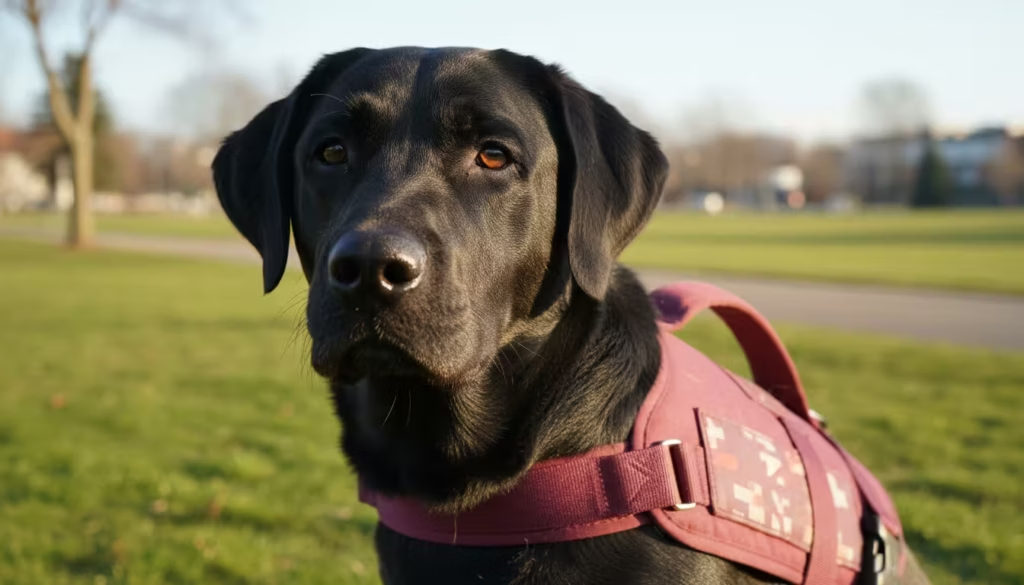
Linda’s experience highlights several undeniable truths for every dog owner. Firstly, the immense value of clarity in communication. Toffee’s burgundy jacket, denoting him as a Hearing Dog, makes Linda’s deafness visible. This external signal facilitates understanding from the public, a concept directly paralleling the need for clear communication within the training dynamic between owner and dog. When you are clear with your dog, using consistent cues and predictable consequences, you build a foundation of trust and understanding that enables them to perform reliably in complex environments. Secondly, the freedom that results from reliable training is not a luxury; it is a fundamental aspect of welfare for both dog and human. Linda can now sleep without fear, knowing Toffee is her alarm system. She can secure her home, confident that she will be alerted to visitors. These are not minor conveniences; these are significant improvements to safety and quality of life, directly attributable to Toffee’s learned skills.
This partnership is a direct reflection of what is possible when an organization, and subsequently an owner, commits fully to a dog’s training and integration. It demands consistency, patience, and a deep understanding of behavioral principles. There is no magic, only the unwavering application of science-based training methodologies.
Beyond the Call of Duty: Jerry, The Seeing-Eye Dog with a Lifesaving Sense
Next, we turn to Luis Perez and his black Labrador, Jerry. Jerry, primarily trained as a seeing-eye dog, performed an extraordinary act of vigilance by alerting Luis to a deep vein thrombosis (DVT) in his leg. This case presents a fascinating intersection of highly trained behaviors and what appears to be an intuitive, deeply attuned response. Jerry’s primary function is guidance, a complex set of behaviors involving navigation, obstacle avoidance, and intelligent disobedience, all painstakingly trained over months, if not years. His persistent chin-pressing on Luis’s leg was an unprecedented deviation from his trained tasks, yet it saved a life.
While the DVT detection may appear to be an instinctual act, it is crucial to recognize the underlying factors that enable such an alert. A service dog like Jerry operates within a framework of profound connection and attentiveness to their handler. This bond is not passive; it is forged through countless hours of structured interaction, mutual reliance, and an environment where the dog is encouraged to pay close attention to its human partner. Such heightened awareness, even when not explicitly trained for medical detection, can manifest in critical ways when a significant change occurs in the handler’s physical state. Owners often fail to cultivate this level of reciprocal observation. You must be as attuned to your dog’s subtle cues as you expect your dog to be to yours. Jerry’s action underscores the absolute necessity of fostering a strong, engaged relationship built on clear communication and consistent interaction. This isn’t about hoping for a miracle; it’s about creating an environment where a dog is optimally positioned to perceive and react to important changes, within or beyond its trained repertoire.
The Non-Negotiable Foundation: Uncompromising Veterinary Care
Both Toffee and Jerry demonstrate the pinnacle of canine capability, but their effectiveness, and indeed the effectiveness of any training, rests on a critical, often overlooked foundation: health. This brings us to the news from Dovecote Veterinary Specialists, who have invested £1 million in upgrading their Derby hospital. This is not merely an interesting industry update; it is a stark reminder to every dog owner about the undeniable link between a dog’s physical health and its capacity for training, behavior, and overall well-being.
You cannot expect a dog to perform reliably, integrate smoothly into a household, or even learn basic obedience if it is suffering from pain, illness, or chronic discomfort. A dog with an undiagnosed orthopedic issue will not reliably sit or heel. A dog experiencing chronic dental pain will likely exhibit irritability or aggression. A dog with gastrointestinal distress will struggle with house training and focus. These are not excuses; these are biological realities. The advanced diagnostics – the 64-slice CT scanner – are not luxuries; they are tools for precise identification of underlying issues. The dedicated chemotherapy suite, the expanded ICU, and the species-specific wards are not excessive; they are essential components of comprehensive care that address serious conditions and minimize stress during recovery.
Responsible dog ownership is not simply about feeding and walking; it is about providing proactive, high-quality veterinary care. This means regular check-ups, prompt attention to any signs of illness, and a willingness to invest in specialized treatment when necessary. A healthy dog is a trainable dog. A dog suffering in silence will never reach its potential, regardless of how many training classes you attend. Do not equivocate on this. Your dog’s health is paramount, and it is a direct reflection of your commitment as an owner.
Your Mandate: Action Over Apathy
These stories are not here to inspire fuzzy feelings; they are here to provide clear evidence and a direct mandate. The extraordinary capabilities of dogs like Toffee and Jerry are the direct result of systematic, evidence-based training and profound human-canine partnerships. Such partnerships are impossible without a bedrock of excellent health. Are you providing the structure, the consistency, the positive reinforcement, and the uncompromising veterinary care that your dog deserves? If you are not, you are failing your dog, and you are limiting its potential. Stop making excuses. Start taking concrete, actionable steps to ensure your dog is healthy, well-trained, and a fully integrated member of your life. The results, as these cases clearly demonstrate, are invaluable.