
Imagine this familiar scenario: You come home from a long day of work. You’re exhausted, but your dog has been waiting patiently all day. Knowing they have energy to burn, you clip on the leash, lace up your running shoes, and take them on a brisk three-mile jog. Or perhaps you stand in the backyard launching a tennis ball until your arm aches. You head back inside, confident that your dog is finally worn out.
Ten minutes later, they are pacing the living room, bringing you a toy, and whining.
As a dog trainer and behaviorist, I see this cycle constantly. We humans equate physical exhaustion with total exhaustion. We assume that if we just run the dog hard enough, they will eventually settle down and sleep. But what if I told you that in your quest to drain your dog’s physical energy, you are completely ignoring their most powerful, energy-consuming organ?
The secret to a calm, relaxed, and genuinely tired dog isn’t found in a marathon sprint. It is found in a concept called the “Sniffari.”
What Exactly is a “Sniffari”?
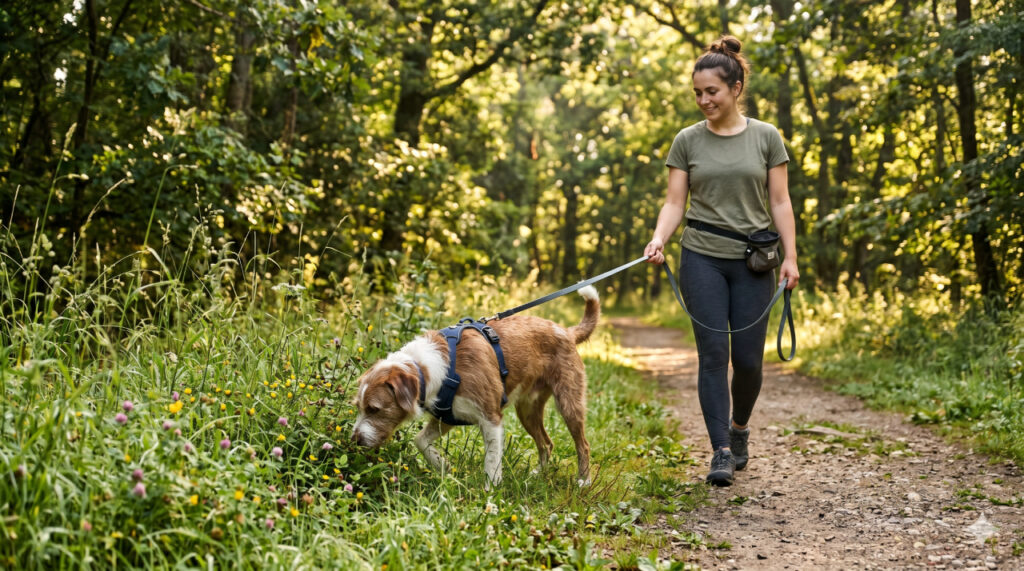
A Sniffari—often referred to in the dog training world as a decompression walk—is a walk where the primary goal is not physical distance, but sensory exploration. It is a walk entirely dictated by your dog’s nose.
During a standard exercise walk, the goal is movement. You keep a brisk pace, you ask your dog to walk relatively close to you, and you gently pull them along when they stop to investigate a fire hydrant or a patch of grass. You are focused on the destination and the cardiovascular burn.
A Sniffari flips this dynamic upside down. On these walks, the dog sets the pace. If they want to spend four uninterrupted minutes analyzing the scent left behind by a squirrel at the base of an oak tree, you stop and let them. The objective is to let them gather as much olfactory data from their environment as possible.
The Science: Brain Work vs. Leg Work
To understand why a Sniffari is so exhausting for your dog, we have to look at the biology of the canine nose.
Humans are visually dominant creatures. We navigate and understand our world primarily through sight. Dogs, however, are olfactory creatures. They “see” the world through their noses. While a human nose has roughly 5 to 6 million olfactory receptors, a dog’s nose boasts an astonishing 300 million. Furthermore, the part of a dog’s brain dedicated to analyzing odors is proportionally 40 times larger than ours.
When your dog stops to sniff a tree, they aren’t just smelling “dog.” They are reading a highly detailed environmental newsletter. They can determine the gender of the dog that passed by, their age, their health status, what they ate for breakfast, and what mood they were in.
Processing this massive amount of complex data requires an immense amount of cognitive energy. Think about the last time you spent hours focusing intently on a difficult spreadsheet or studying for a complex exam. You likely felt completely drained afterward, even if you hadn’t moved from your chair. Mental fatigue is just as real, and just as exhausting, as physical fatigue. For a dog, 15 to 20 minutes of intense, uninterrupted sniffing burns as much mental and physical energy as an hour of brisk walking.
Furthermore, sniffing has a direct, profound impact on your dog’s nervous system. A fascinating 2019 study published by researchers Charlotte Duranton and Alexandra Horowitz (read the study here) demonstrated that allowing dogs more time to engage in nose work actually makes them more “optimistic” and improves their overall welfare. Engaging their olfactory system triggers the parasympathetic nervous system—the part of the body responsible for rest and digestion. It actively lowers their heart rate, reduces stress, and promotes a deep sense of calm.
Why Running Your Dog Might Be Making Things Worse
If you have an incredibly high-energy breed—like a Malinois, a German Shepherd, or a Working-line Labrador—you might think that running is the only way to manage them. But leaning strictly on physical exercise often backfires in two distinct ways:
1. You are building a canine Olympian. When you run your dog for three miles a day, their body adapts. Their cardiovascular health improves, their muscles strengthen, and their stamina increases. Within a month, three miles won’t tire them out anymore; they will need five. Then they will need seven. You are inadvertently training an elite athlete that requires more and more physical output to feel satisfied. You will break down before they do.
2. The Cortisol Trap. High-intensity, fast-paced physical activities—especially repetitive games like fetch—are highly arousing. They trigger the release of adrenaline and cortisol (the stress hormone) in your dog’s brain. While your dog may be physically panting and lying down after an hour of fetch, their brain is still swimming in a cocktail of arousal chemicals. This is why so many dogs seem physically tired but remain hyper-vigilant, anxious, or unable to settle. Sniffing does the exact opposite; it naturally lowers cortisol levels and acts as a neurological reset button.
How to Take Your Dog on a Proper Sniffari (Step-by-Step)
Executing a Sniffari is easy, but it requires a mental shift on the part of the owner. Here is how to set your dog up for success.
Step 1: The Gear Setup
You cannot go on a proper Sniffari with a standard 4-foot or 6-foot leash attached to a flat collar. The dog needs the freedom to move naturally and drop their head to the ground without feeling leash tension.
- The Harness: Use a well-fitted, comfortable Y-front harness. Avoid restrictive no-pull harnesses for these specific walks, as we want the dog to have a full, natural range of motion.
- The Leash: Invest in a 15-foot to 30-foot long line (biothane is highly recommended as it won’t tangle easily in brush and is waterproof). Never use a retractable leash. Retractable leashes maintain constant tension on the dog, which discourages relaxed, natural movement and teaches them to pull.
Step 2: Location Scouting
The environment matters. A busy city sidewalk next to loud traffic is not conducive to a relaxing Sniffari. Look for nature-rich environments. Hiking trails, wooded areas, large empty parks, or even a quiet cemetery (where permitted) are perfect. You want an environment rich in novel scents—wildlife, decaying wood, different grasses, and moisture.
Step 3: The Golden Rule: Follow, Don’t Lead
Once you arrive, let out the long line and give your dog permission to explore. From this point on, you are merely the chauffeur. If your dog zig-zags across the grass, you follow safely behind. If they find a fascinating patch of dirt and want to sniff it for five solid minutes, you wait patiently.
Do not rush them. Do not tug on the leash and say, “Come on, let’s keep moving.” Remember, the goal is not to travel a specific distance. The goal is to let their brain process the environment.
The Hidden Benefits for Reactive Dogs
If you are working with a reactive dog—a dog that lunges or barks at other dogs, people, or vehicles—incorporating Sniffaris into their routine can be a game-changer. Reactivity is almost always rooted in fear, anxiety, and an overloaded nervous system.
By taking your reactive dog to a quiet, secluded area and allowing them to sniff, you are helping them decompress and empty their “stress bucket.” Regular decompression walks lower their baseline cortisol levels, meaning they will be less easily triggered in their day-to-day life. Additionally, teaching a dog to drop their head and sniff on cue can be used as an excellent alternative behavior when they spot a trigger in the distance.
FAQ: Common Sniffari Mistakes to Avoid
“My dog just wants to run and doesn’t seem interested in sniffing. What do I do?” Many dogs have been conditioned to believe that walks are high-speed, forward-moving missions. If your dog is frantic, try scattering a handful of high-value, smelly treats (like dried liver or cheese) into tall grass and tell them to “find it.” This forces them to put their nose down and engages the olfactory system. Once they start, the environment will usually naturally take over.
“Is it okay if they eat things they find?” Sniffing is encouraged; scavenging for dangerous items is not. Keep an eye on what your dog is investigating. If they find something unsafe, calmly call them away and reward them heavily with a safe, high-value treat from your pocket.
“Should I completely stop taking my dog for exercise walks or runs?” Absolutely not! Physical exercise is still vital for your dog’s cardiovascular health, joint mobility, and weight management. The goal is balance. Instead of doing a fast-paced walk every single day, try substituting two or three of those sessions a week with a slow, deliberate Sniffari.
The 15-Minute Challenge
If you are currently struggling with a dog that seems impossible to tire out, I challenge you to change your routine this week. Tomorrow, instead of grabbing the tennis ball or running your usual two-mile loop, put on a long line, drive to a quiet park, and let your dog lead you by the nose for just 20 minutes.
Watch their body language as they work through the scents. Watch how deeply they sleep when you get back home. By allowing your dog to tap into their natural canine instincts, you are not just draining their energy—you are fulfilling their deepest biological needs, resulting in a happier, healthier, and much more relaxed companion.